Category coverage
The primary category sets the main lane. Secondary categories and service groups extend coverage without turning the profile into a junk drawer.
Google Business Profile
Categories. Services. Photos. Reviews. Updates.
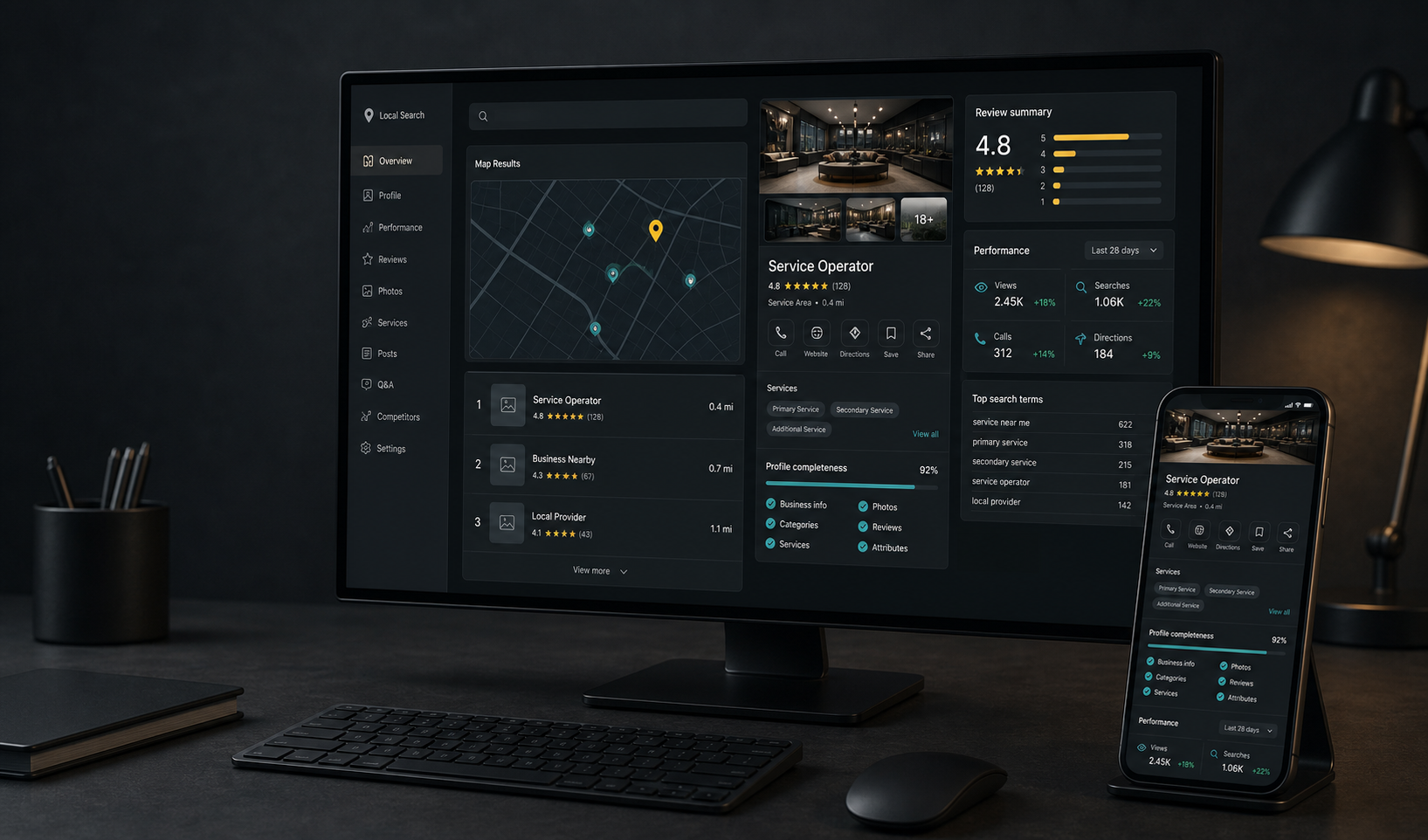
Your Google Business Profile is the local search briefing card. It carries the name, category, hours, services, photos, reviews, directions, calls, booking links, menu paths, and updates buyers inspect before they act. If that card is thin, stale, or inconsistent, the market sees hesitation before it sees proof.
Axis37 treats GBP as Foundation infrastructure. The profile must carry accurate categories, structured services, current hours, real photos, review activity, useful updates, Q&A, attributes, and action links. Then it has to match the website, schema, citations, and service-area structure so every surface gives the same answer.
A profile that looked complete last year can be wrong today. Services change. Hours drift. Photos age. Reviews compound or stall. Google-suggested edits can rewrite the public facts.
Google cannot rank, Maps cannot guide, buyers cannot compare, and AI systems cannot cite what the profile fails to make clear.
The primary category sets the main lane. Secondary categories and service groups extend coverage without turning the profile into a junk drawer.
Google can highlight services when buyers search for them. The profile should carry the same named work the website and schema carry.
Photos should show the real operation: work, team, place, equipment, finished results, menu items, or field proof depending on the vertical.
Review velocity belongs to Authority, but the profile carries it. Responses show activity and give buyers a second proof point.
GBP work becomes serious when each signal is tied to a specific constraint. The Recommendation Report turns profile maintenance into an operating cycle instead of a task list.
See a Sample Recommendation ReportUseful GBP work is not profile decoration. It tightens the facts buyers, Google, Maps, and AI systems use to decide whether the company belongs in the answer.
Google says local results are mainly shaped by relevance, distance, and prominence. GBP work has to serve all three. A profile with a weak category set may never enter the right result set. A profile with inconsistent market signals may be filtered before the buyer compares anyone.
The profile should match the website, schema, citations, and service-area pages. When every surface says the same thing, Google and AI systems have less to reconcile.
Service entries are not filler. They are named inventory. Google can highlight services on the profile when buyers search for that work, which means the profile needs the right services grouped under the right categories.
The discipline is simple: no vanity services, no keyword stuffing, no mismatched categories. Only the work that matters and can be performed well.
Google allows photos and videos that show the storefront, products, and services. The useful standard is stricter: every image should make the company easier to verify.
Updates, offers, and events help buyers see current information on Search and Maps. Q&A closes the gaps buyers repeatedly ask before they call.
Google may update profile information from other sources, user reports, and licensed content. That is not a footnote. It means abandoned profiles drift.
Axis37 reviews profile changes as part of the operating cycle so wrong hours, wrong services, stale attributes, or bad third-party data do not become the answer buyers see.
The work is not finished because a post went live or a photo uploaded. It is working when the profile earns better visibility, stronger buyer actions, cleaner AI answers, and a higher Foundation Footprint.
The Recommendation Report tracks the movement and names what changes next.
Axis37 rebuilds and maintains the profile as part of the Foundation phase: category coverage, service inventory, photos, updates, Q&A, attributes, links, hours, Google updates, and measurement. If the Footprint Score is not moving, the cadence changes.
GBP gets maintained with the same discipline as service pages, citations, reviews, and tracking.
Map categories, services, attributes, hours, links, photos, reviews, updates, Q&A, and Google-suggested changes.
Make the profile match website pages, schema, citations, service areas, and the work you want more of.
Configure category coverage, service groups, descriptions, attributes, booking links, menus, products, or appointment paths where relevant.
Add recent photos, updates, offers, events, and direct Q&A that help buyers verify the company.
Review Google updates and third-party data signals before bad information hardens into the public result.
Use the Report to connect profile work to Map Pack visibility, profile actions, AI answers, and the Footprint Score.
A plumber, attorney, restaurant, roofer, and HVAC company should not run the same profile pattern.
Categories, services, photos, hours, posts, and review language aligned with the plumbing work you want more of.
See the vertical ->RoofingGBP for roofingProfile categories, services, photos, posts, and review signals aligned with roofing search behavior.
See the vertical ->HVACGBP for hvacCategories, services, products, photos, hours, updates, and reviews aligned with HVAC demand cycles.
See the vertical ->RestorationGBP for restorationCategories, hours, service list, and real job photos set up so an 11pm emergency search returns a company that looks open and legitimate.
See the vertical ->ElectricalGBP for electricalCategories, service list, license detail, hours, and finished-work photos aligned with the jobs that carry real margin.
See the vertical ->Law FirmsGBP for law firmsCategories, services, photos, Q&A, reviews, and profile facts aligned with how legal services appear in local search.
See the vertical ->RestaurantsGBP for restaurantsCategories, attributes, menus, photos, posts, hours, reservation links, and review signals aligned with dining discovery.
See the vertical ->Yes. For local companies, the profile is often the first surface buyers inspect and one of the first sources Google uses to understand the company. Claimed is not the same as maintained.
The profile should be reviewed monthly at minimum. Photos, updates, Q&A, hours, attributes, services, and Google-suggested changes all need a cadence.
Yes. The primary category affects eligibility for local results, so changes should be deliberate. Axis37 maps category changes against service priorities and watches the result.
Posts are not a magic ranking switch. They help keep current information visible on Search and Maps, support buyer decisions, and create another maintained signal inside the profile.
AI systems need clean facts about what the company does, where it works, and why it can be trusted. GBP is one of the structured sources those systems can use or cross-check.
The Search Checkup reviews category coverage, services, photos, reviews, updates, Q&A, Google edits, and the connection between the profile and the rest of the search footprint.
Get My Search Checkup