Social Media Marketing
Social mediathat makes theoperator easierto trust.
Real work. Reviews. Proof. Community.
Posts should show the company is active, credible, specific, and safe to choose before the buyer is ready to call.
The hook
Buyers inspect the proof before they raise their hand.
Social media should not be a posting calendar with a logo on it. It should show that the company is active, credible, specific, and safe to choose before the buyer is ready to call. Axis37 treats organic social as Authority infrastructure: real work, review themes, service education, local participation, short-form proof, and measurement tied back to the search footprint.
Real workVisible proof
ReviewsThemes buyers trust
EducationQuestions answered
CommunityLocal presence
TrackingAction, not vanity
Quick answerWhat does social media marketing do?
It turns the company's real activity into visible proof buyers can inspect.
Social media marketing is the Authority work of turning real activity into proof: recent jobs, team presence, review themes, service education, local participation, offers, and buyer questions. Axis37 uses social to support trust, search, AI visibility, and conversion. The goal is not to look busy. The goal is to make the company easier to trust before the buyer acts.
What mattersFollowers are not the strategy. Visible proof is.
A buyer may see the social profile before the website, after reading reviews, or while comparing two local options. If the feed is stale, generic, or disconnected from real work, it weakens trust at the exact moment proof matters.
Authority layerThe feed should make the company easier to verify.
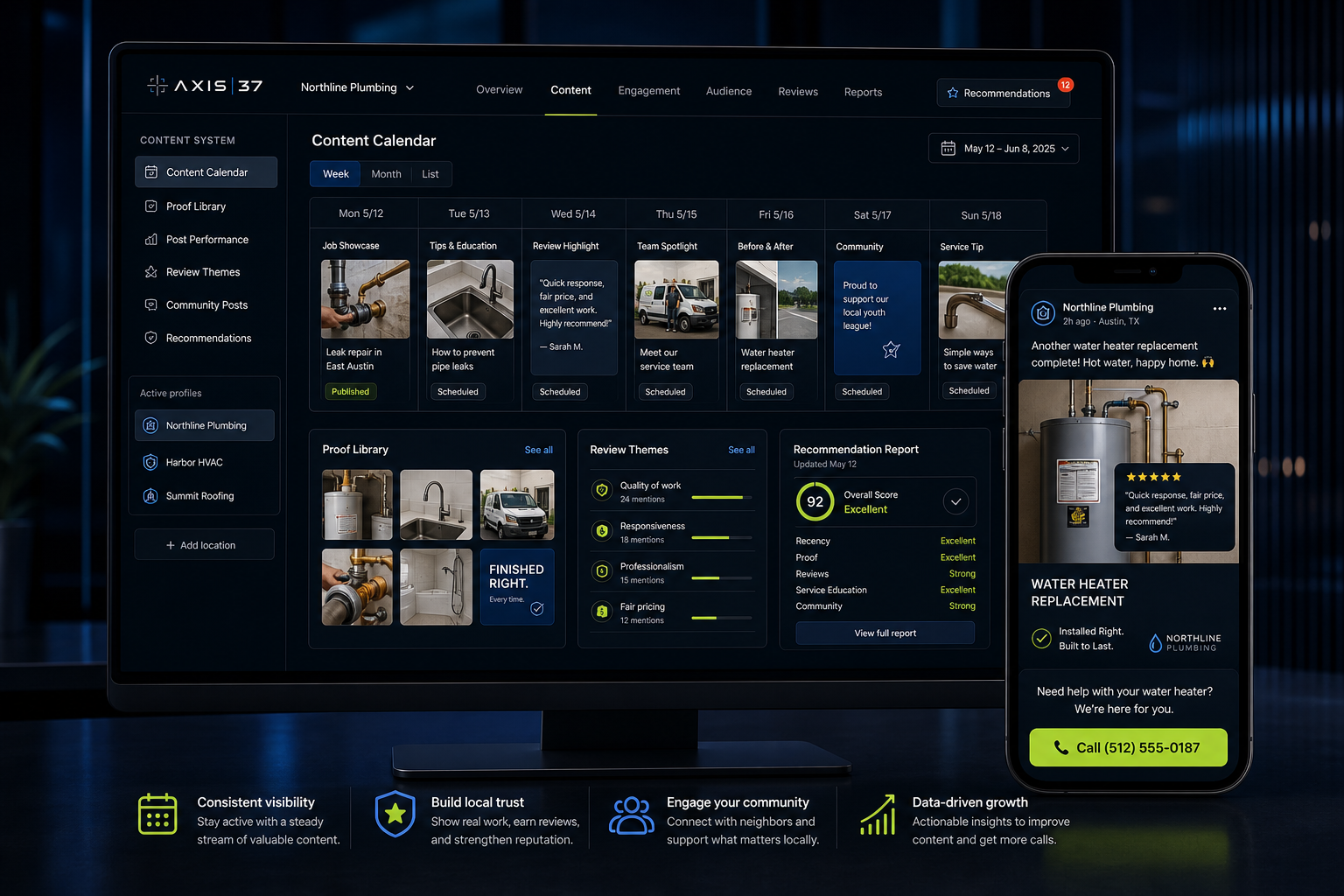
Useful social content turns real work, review themes, service education, and local proof into surfaces buyers can inspect before they act.
- Real work
- Reviews
- Education
- Community
- Tracking
SignalWeak patternAuthority pattern
Profile stateBio, links, photos, and contact paths driftProfiles match the website, GBP, and service footprint
Content sourceGeneric posts from a calendarReal jobs, reviews, team proof, and local context
Buyer hesitationPosts talk around the decisionContent answers the doubts that stop action
Platform fitSame post pushed everywhereFormat and cadence match the platform and vertical
Paid socialBudget used to boost weak contentAds amplify proof that already earns attention
MeasurementLikes and impressions become the reportThemes are tied to actions, calls, visits, and next moves
Service guideHow social media earns its place in the system.
Useful social content gives buyers and search systems more proof to work with. It has to be specific, current, and tied to real outcomes.
01Clean up the public profiles before the calendar starts.
The profile is often the first inspection point. Name, category, bio, links, service areas, highlights, pinned posts, photos, and contact paths should match the website, GBP, and citations.
A polished content plan cannot fully cover a profile that sends mixed signals about what the company does or where it works.
Turn real work into proof.
The strongest posts come from the operation itself: finished jobs, team process, before-and-after context, behind-the-scenes decisions, menu or service detail, case-type education, and local participation.
The content should make the company easier to inspect. It should not read like a stock caption with a logo attached.
- Recent jobs and outcomes.
- Review themes turned into posts.
- Service education for buying decisions.
- Local proof and community context.
- Short-form clips with a clear point.
Use review themes to decide what gets posted.
Reviews reveal what buyers actually value: response time, clean work, communication, patience, speed, taste, care, confidence, or clear next steps.
Those themes should shape the content calendar. If buyers keep praising the same strength, the feed should make that strength visible before the next buyer asks.
Match platforms to the buyer path.
Posting everywhere is not discipline. YouTube, Facebook, Instagram, TikTok, LinkedIn, and vertical platforms each carry different buyer intent and content expectations.
Axis37 chooses the channel mix by vertical, market, proof type, and capacity. A law firm does not need the same feed as a restaurant or HVAC company.
Keep paid social separate, but connected.
Paid social is a different operating cycle: budget, targeting, creative testing, lead forms, retargeting, and attribution. It deserves its own plan.
Organic social builds the proof layer paid social can amplify. Ads can spread a useful signal. They cannot fix thin proof, unclear offers, or broken tracking.
Measure themes, not vanity activity.
The Recommendation Report should show which themes, services, posts, and platforms are supporting profile actions, website visits, calls, form starts, and AI or search visibility.
If the content is not strengthening the footprint or creating action, the calendar changes.
Paid socialPaid social belongs on top of a proof system.
Ads can amplify a useful message. They cannot fix thin proof, weak creative, unclear offers, or broken tracking. Axis37 treats paid social as a separate Conversion channel because budget, targeting, creative testing, and attribution need their own operating cycle.
01Proof firstOrganic content shows real work, review themes, and buyer hesitation.
02Creative testWinning proof becomes ad creative, retargeting, and offer testing.
03Tracked actionSpend gets judged by calls, forms, bookings, and qualified opportunities.
The offerPosting is not the offer. Proof discipline is.
Axis37 builds organic social around the proof buyers already want: real work, reviews, service education, local participation, current profiles, and tracked action paths. The output is a feed that supports search, reputation, conversion, and AI visibility instead of a calendar that only proves someone posted.
01Profile cleanup across bios, links, highlights, categories, and contact paths.
02Content map built from real services, review themes, and buyer hesitation.
03Short-form proof and post formats matched to each vertical and platform.
04Publishing cadence tied to capacity, not arbitrary volume.
05Social actions and content themes reviewed in the Recommendation Report.
ProcessHow the social system gets run.
The work runs as an operating cycle: profiles, proof, publishing, action paths, and monthly guidance.
01Audit profiles
Review bios, links, categories, pinned posts, highlights, photos, cadence, and profile consistency.
02Map proof
Choose the services, review themes, local signals, and buyer questions that deserve content.
03Capture work
Build a repeatable way to collect photos, short clips, notes, reviews, and field proof.
04Publish purpose
Ship posts, short clips, updates, and proof assets around the buyer path instead of filler.
05Connect action
Tie links, calls, forms, bookings, and profile actions back to the content and platform where possible.
06Tighten monthly
Use the Report to see which themes support trust, search, AI visibility, and conversion.
FAQs
Questions that come up before social work starts.
Is social media marketing only for brand awareness?
No. Awareness is part of it, but organic social should also support proof, reputation, service education, local trust, profile activity, and conversion paths.
Which platforms should we use?
It depends on the vertical and buyer path. YouTube, Facebook, Instagram, TikTok, LinkedIn, and vertical platforms each serve a different role. Axis37 starts with fit, not platform sprawl.
How often should we post?
Cadence should match proof supply and capacity. A steady rhythm of specific, useful content is stronger than arbitrary volume that turns generic after two weeks.
Should paid social be included?
Paid social should connect to organic proof, but it should be planned separately. Budget, targeting, creative testing, retargeting, lead forms, and attribution need a different operating cycle.
How does social connect to SEO and AI search?
Social profiles, posts, reviews, videos, and public proof can support the broader search footprint. They give buyers and discovery systems more current evidence to inspect.
Do you make the content?
Axis37 builds the content system, plans the themes, shapes the posts, and creates publishable assets from real proof. The strongest work still starts with the operator's actual jobs, team, place, and buyer interactions.