Service-area pages
Clear pages for the services and cities you actually want. Each page should help a buyer in that city understand whether you are the right fit.
Local SEO
Google Maps. Profiles. Pages. Citations.
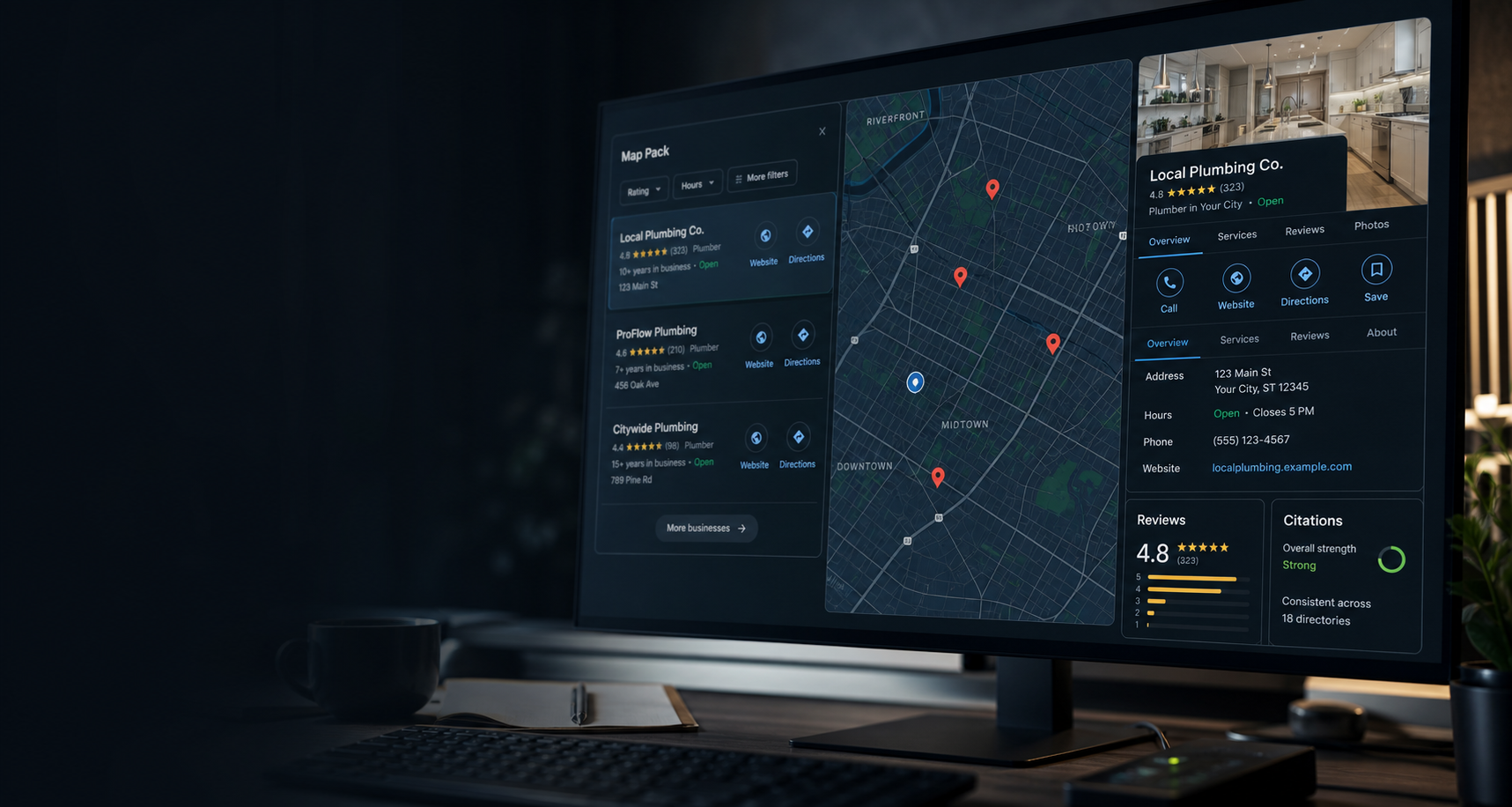
Local buyers see the map result, the profile, the reviews, the hours, the service page, and the nearby proof before they call. If those signals are thin or inconsistent, you are harder to trust and easier to skip. Axis37 treats Local SEO as Foundation work: we make the footprint clear enough for Google, Maps, and buyers to verify.
Local SEO makes the local footprint clear: where you work, what you do, which services you want more of, and why search systems should trust the result. The technical work still matters. Axis37 tightens service-area pages, schema, Google Business Profile categories, and citation consistency so Google, Maps, and local discovery surfaces are reading the same facts.
Better content and more reviews cannot fully fix an unclear local footprint. If Google cannot connect your services, locations, profile, and proof, the rest of the work starts with a lower ceiling.
Local SEO makes the basic facts clear: where you work, what you do, which services matter, and what proof backs it up.
Clear pages for the services and cities you actually want. Each page should help a buyer in that city understand whether you are the right fit.
Structured data gives search systems clean facts to read: service lines, locations, reviews, hours, and business type. The jargon matters only because the extraction matters.
Your name, address, phone, hours, services, and categories should match across Google, Maps, Yelp, Apple Maps, and the directories your vertical relies on.
Each piece answers a simple question: can buyers and search systems confirm what you do, where you do it, and why you should be trusted?
Many local sites have two main service pages and a generic “we serve the area” footer. That does not give Google, Maps, or the buyer much confidence about one city versus another.
The stronger pattern is a dedicated page for each service and city you actually want. The page needs local proof, clear service detail, and language that matches how buyers search. Not thirty thin city pages from a template.
Search systems do not read a page the way a person does. They look for clean facts they can extract: business type, services, location, hours, reviews, and common questions.
That is where schema earns its place. The work can include the right LocalBusiness subtype, Service entries for named services, AggregateRating from real reviews, FAQPage markup, and OpeningHoursSpecification.
Buyers compare what your website, Google Business Profile, Yelp, Apple Maps, and vertical directories say. Search systems compare the same sources.
When those surfaces tell slightly different stories, trust drops. The fix is disciplined cleanup: audit the stack, fix mismatches, close duplicate listings, and keep hours, services, and categories aligned.
Directory submissions and NAP cleanup have a place. They are not the strategy. Axis37 starts with the structure that changes what buyers and search systems can verify: service-area pages, schema, Google Business Profile cleanup, citation consistency, and monthly measurement tied to the queries that book work.
The Report shows which cities are improving, which queries stayed stuck, and what is blocking the next move. It turns Local SEO from a checklist into a monthly decision system.
emergency plumber near me
Primary cityTrack weeklyProfile proofroof repair after storm
North service areaBuild pageCity proofcommercial lease lawyer
DowntownClean citationsCategory matchprivate dining restaurant
West sideTighten GBPService clarityWe map your service-area pages, schema, citation stack, and Map Pack visibility against the buyers you actually want.
Service-area pages, schema markup, citation cleanup, and Google Business Profile optimization. One service and city at a time.
The monthly Recommendation Report shows which cities improved, which queries stayed stuck, and what has to be fixed next. Footprint Score updates monthly.
The same Foundation logic applies. The service-area math, proof signals, and buyer intent change by vertical.
Local SEO for plumbing operators built to become the obvious answer in their market. Google, Maps, reviews, AI answers — one operating system underneath. From Axis37.
Read the guide ->Local SEOLocal SEO for HVAC contractorsLocal SEO for HVAC operators built to become the obvious answer through every season. Google, Maps, brand-name searches, AI engines — one operating system underneath. From Axis37.
Read the guide ->Local SEOLocal SEO for roofersLocal SEO for roofing operators built to become the obvious answer when a storm hits. Authority that lasts past the next hailstorm. Recommendation Report monthly from Axis37.
Read the guide ->SEOSEO for law firmsSEO for law firms built to become the obvious choice when a serious case is selecting. Practice-area depth, attorney-bio E-E-A-T, AI-engine citation. Recommendation Report monthly from Axis37.
Read the guide ->Local SEOLocal SEO for restaurantsLocal SEO for restaurants and hospitality operators — Google Maps, Yelp, OpenTable, Resy, AI 'best near me' prompts, and the Axis37 Recommendation Report.
Read the guide ->No. Citation hygiene is part of the work, but it is not the spine. The bigger question is whether Google can clearly verify your services, locations, profile, reviews, and proof signals. Submissions without that do not compound.
Many teams see Map Pack movement by month two or three, depending on the starting Footprint Score, local competition, and how much cleanup is needed.
No. You need pages for the services × cities you actually want more work in. A roofer who works five cities ships five city pages, not thirty.
Local SEO is Foundation work. AEO compounds on top of it. If the local footprint is unclear, answer engines have a weaker basis for confirming where you work and what services you provide.
The Search Checkup shows whether your service-area pages, Google Business Profile, schema, citations, and Map Pack visibility are helping or holding you back. Then it names the first move to make.